The most influential regulator of artificial intelligence across America hasn’t been the President or the Secretary of Commerce. Nor has it been the chairs of the Federal Trade Commission or the Federal Communications Commission; the House Judiciary, Science, or Oversight Committees; or the Senate Intelligence or Commerce Committees.
It’s been Kathy Hochul, the Governor of New York and a candidate for reelection this November.
In July, Hochul signed an executive order imposing the country’s first statewide moratorium on hyperscale data centers, pausing permits for facilities of 50 megawatts or more for up to a year while the state builds a new regulatory framework. It was by no means a comprehensive act to govern LLMs and the AI industry writ large; for all intents and purposes, it won’t, on its own, slow down the industry’s growth.
But Hochul’s strategy is nevertheless proving contagious on both sides of the political aisle. Texas Gov. Greg Abbott has since similarly frozen grid approvals for roughly 1,800 data center projects in his state, pending an audit, while Pennsylvania Gov. Josh Shapiro signed an order blocking any project in his state that doesn’t first win local approval and sign binding commitments on energy costs, water, and transparency.
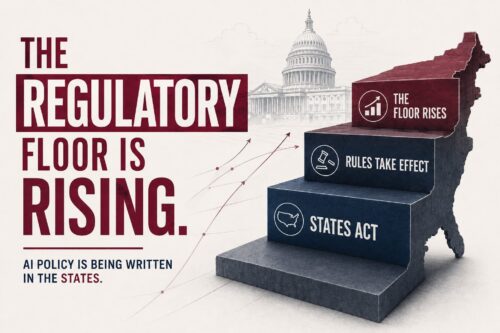
Expect this trend to continue. With the federal government stuck in partisan gridlock and a White House that’s spent the year fighting states and focusing elsewhere, the rules that will actually govern AI aren’t going to be written in Washington anytime soon. Instead, they’re going to be written in Albany, Austin, Harrisburg, and the dozens of statehouses in between. States are raising the regulatory floor, one law and one executive order at a time. And the companies that understand that–and build a strategy around that–will have a head start in this new AI era.
The Pattern
To those of us who have spent a lifetime studying and shaping how power actually moves in our country, this pattern is familiar. Throughout our history, every time a new industry has come along and reshaped American life faster than Congress can (or chooses to) act, states have stepped up to fill the vacuum.
In the early 1870s, big rail monopolies and grain-storage operators started gouging Midwestern farmers with arbitrary freight rates. There was no federal law on the books to stop them, so Illinois, Minnesota, Iowa, and Wisconsin stood up their own railroad commissions to cap what carriers could charge. Congress didn’t catch up until 1887, when it created the Interstate Commerce Commission.
When the century turned, and electricity and telephone lines began racing across the country with zero federal oversight, New York and Wisconsin became the first states to build real public service commissions, with the power to cap rates and approve utility investment. Within seven years, 43 states had followed suit. Congress wouldn’t pass the Public Utility Holding Company Act until 1935–nearly three decades later.
And when the postwar auto boom left Los Angeles choking on smog, California created the nation’s first vehicle pollution control board in 1960, forcing automakers to install the first emission-control devices–a full decade before the federal government set truly binding national standards in the 1970 Clean Air Act.
God bless Washington; the federal government often tends to show up to big, consequential public policy fights like an insurance adjuster shows up at the scene of a car accident–long after the issue at hand first arose, and primarily ready to argue about who’s at fault. State and local governments don’t have that luxury.
So what does that mean for AI regulation in the 21st century? Congress and the Executive Branch will likely spend years tinkering in the margins, setting the upper boundary of what’s legally allowable, before ultimately making a big, rare burst of legislative progress. When Washington’s moment does come, it will belong to the party whose vision is sweeping enough to consolidate what the states have already built—something Democrats with an eye towards 2028 would be wise to remember. In the meantime, the states will continue to move constantly, on dozens of parallel tracks, to raise the regulatory floor.
And that floor is rising fast.
States Lead
Just three years ago, fewer than 200 AI-focused bills were introduced in state legislatures across the country. Some amounted to nothing more than forming a committee to study AI further.
That churn has since grown exponentially, across blue and red states alike. In the first three months of this year alone, more than 1,500 AI bills were introduced in 45 statehouses. Twenty-four states have now passed comprehensive privacy laws covering more than half the country’s population–four of them this year alone. In June, a bipartisan coalition of 42 state attorneys general came together to subpoena OpenAI, demanding records on how it markets to kids, handles health data, and designs its models to keep people engaged. Moratorium bills have also been introduced in legislatures in at least 15 states.
Congress, meanwhile, has had its attention torn elsewhere—to Trump’s various wars of choice, the cost-of-living crisis, and the fall campaign season, where AI-backed Super PACs have spent hundreds of millions of dollars with incongruous objectives, scrambling the legislature’s priorities. As a result, it’s made zero progress on anything resembling a comprehensive AI framework.
And the Trump administration, for all its talk of a national AI framework, has in reality spent the better part of its term half-heartedly attempting to undermine state regulators–issuing a proposed FTC policy statement, ordering up an FCC proceeding, dangling $42 billion in broadband funding as leverage, and standing up a Department of Justice task force to sue states over their AI laws. It all traces back to a presidential Executive Order signed last December aimed at preempting state AI regulation altogether.
But that order carved out three big exceptions: child safety, data center infrastructure, and state procurement. Even this White House understood it couldn’t touch those without setting off a political firestorm. So Washington is again setting a ceiling–one that has significant holes. And those holes are exactly where states are pushing hardest.
What Comes Next
That state-level aggressiveness will only increase after Election Day, because the people charged with writing, enforcing, and raising the regulatory floor are running on strong, pro-regulation platforms.
This November, 30 attorneys general and 36 governors are up for election. Several AG offices will change hands purely on term limits and retirements, and more than a few sitting attorneys general are running for governor themselves. And across these races, AI and data center politics are scrambling the usual math.
That a single month this summer saw the Democratic Governor of Pennsylvania backtrack on years of courting AI companies to his state and the Republican Governor of Texas–who had previously touted his state as the “epicenter” of American AI–freeze data center approvals is not a coincidence. It’s a sign of where the political energy is.
Whatever happens on Election Day, power is going to reshuffle, and the newly elected officials taking office in January will, by and large, arrive with mandates to do something about the rapid, unfettered spread of AI into their states and their constituents’ backyards.
What they do with those mandates will matter enormously–and not just for Big Tech. Texas and Nebraska have already passed privacy statutes with no revenue or user volume threshold. And there’s no Fortune 100 carve-out on any table. Every company doing business with data, in any state, is in scope.
And with Trump in the White House through 2028, his appointees running the relevant agencies, and Congress likely to stay gridlocked, especially if control flips to Democrats, meaningful federal AI legislation remains a long shot.
Don’t Get Crushed
This is a memo about AI regulation… but it’s equally relevant to environmental regulation, housing and land use, and public safety and surveillance technology, among numerous other rapidly evolving and hugely consequential issues of public policy. Washington is paralyzed by partisanship, and there’s no indication that’ll change any time soon. States are going to keep raising the regulatory floor across huge swaths of American life.
Smart businesses will recognize this reality, and they’ll build an engagement strategy that takes the statehouse just as seriously as it takes the White House. The best time to build relationships and earn public goodwill is before moratoriums are signed and subpoenas are issued.
Companies that get this right will build themselves an early, durable advantage.
And the ones that don’t will find themselves feeling like Indiana Jones and Short Round in Temple of Doom–watching the spikes come down and the walls close in, scrambling for a release lever they can’t reach.